World's Largest Wildlife Crossing Already in Use in California Before Official Opening
Bridge over Highway 101 near Los Angeles already shows coyotes crossing safely; official opening set for December 2
By AmeriNews Newsroom ·
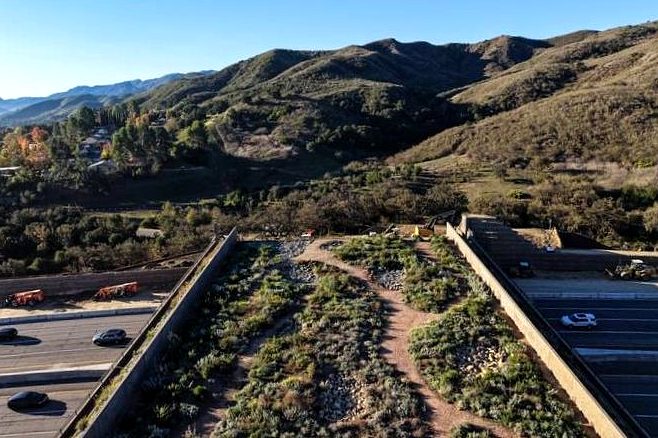
The largest wildlife crossing ever built in the world has begun receiving visitors even before its official opening ceremony, set for December 2. The structure, erected over U.S. Highway 101 and an access road about 56 kilometers northwest of downtown Los Angeles, is already being used by animals crossing between areas of newly planted native vegetation.
Beth Pratt, president of the nonprofit Wildlife Crossing Fund and one of the project's leaders, said she heard birds singing during a recent visit to the site, high above one of the busiest highways in the United States. Motion-sensor cameras recorded, two weeks earlier, a lone coyote crossing the bridge — the first mammal to make the trip safely. Days later, three young coyotes were spotted playing in the vegetation beneath the three-meter-high walls that reduce road noise.
A Link Between Isolated Areas
About 300,000 vehicles travel daily through this stretch of the 101 in Agoura Hills, a small city surrounded by protected lands that the new crossing now connects. Fences installed along the highway guide animals toward the bridge, which spans 380 meters divided into two sections over the lanes, with landscaping blended into the surrounding hills.
The project was named the Wallis Annenberg Wildlife Crossing, in honor of the late philanthropist whose foundation donated $25 million toward the total $114 million budget — a figure that grew from an initial estimate of $92 million. Funding came from 6,000 donors, along with contributions from organizations and state conservation grants. Actor Leonardo DiCaprio was among the first supporters after the campaign launched a decade ago.
Waiting for the Mountain Lions
For Pratt, the symbolic opening will truly happen only when a mountain lion — a species listed as threatened in California — manages to cross the bridge. The project gained momentum from the story of mountain lion P-22, who lived amid the city and settled in a large Los Angeles park until he was euthanized in 2022 after likely being struck by a vehicle. The animal became a symbol of the loss of genetic diversity among species confined by urban sprawl, and thousands of people attended a memorial ceremony in his honor.
A study by the University of California, Davis, released last week, found that at least 780 mountain lions — 18% of the state's population — are killed by vehicles each year. Mari Galloway, director of the California program at the Wildlands Network, said P-22's story was key to exposing the risks facing this isolated population. Her organization, which was not involved in building the Annenberg crossing, hopes the project will spur new crossings, including one being planned for bighorn sheep in the Mojave Desert.
Biological Monitoring
At the top of the bridge, Caltrans field inspector Anthony Deascentis has already spotted spiders, bees, chickadees, sparrows and hummingbirds using the native vegetation. Jeff Sikich, a National Park Service biologist, said the next step will be installing sensors capable of tracking animals' heart rate, body temperature and activity level, to assess whether they cross the structure relaxed or stressed. According to him, bobcats, deer, gray foxes and a female mountain lion with two cubs have been detected nearby in recent weeks.